
You’re a social media genius and I know you know it, too. Not only are you open, but you’ve publicly claimed space in a landscape that eats ridicule with their gravy. What I mean to say here is that you utilize the mass expanse of space socials offer to smartly fill yourself with. “john compton rules this space,” your profile seems to say, and not only is that likable, it’s healthy. It’s about you, and who cares, otherwise? This account belongs to your email address and you’ll talk about your accomplishments not with ego but with humor and conviction. How, as a writer/poet did you begin the tedious work of celebrity building? Was it a gradual process or something you established through calculated risks? I love knowing how authors choose and are prompted towards self-promotion. It’s a devilish activity that oftentimes gains you enemies. If you’re willing to tell me about it, I’ll listen.
jc: thank you for the compliment. lately, with my health issues i feel like i’ve fallen short but i’m still trying my best! and isn’t social media [the poetry community] sometimes like high school? with the little groups and doors that no one want to open. how most established poets want to shun poets who are stepping into the world. they convince themselves that if they help anyone the spotlight will be removed from themselves, when in actuality the more you help, the more you bring on your stage, the bigger the spotlight becomes.
i am always myself on social media and try to be honest, passionate, inviting, and vocal. your quote is spot on: my profile is like my house, and i decorate it with things i want to say. i block ppl who i’d never let enter my home. i always say do what you want on your profile and if someone doesn’t like it they can kick rocks! [you can just block them!] friends are supposed to be excited for their friends. if they’re not excited—they’re not your friend.
i didn’t get social media until 2020 and it was a wake up call. i wanted everyone in the world to read my poetry, and to do that i had to live on social media and do everything i could possibly think of. i didn’t want to be the person who was happy that i sold 20 books in one year; i didn’t want to be ignored; and i learned that the poetry community was not really a community, so my goal was to break down doors. i wanted to get to know everyone: indie to academic. i wanted everyone to know who i was.
enemies are just people who are jealous! they want to bring you down to a level that is equal to them. promote yourself like no one else is going to promote you and be proud of your work.
Emphasizing ownership of oneself like that on the great big internet is a spiritual experience. You’re witnessed, therefor you live? Something like that. The more Googleable you are the better chances of an afterlife, even if it breathes code in place of clouds. The intelligent ways you utilize socials goes far in promoting your poetry. You know this, too. What’s your advice for those who are struggling with presence? How do you get people to care that you’re writing? What’s your advice on handling internet trolls and hidden bullies? For younger generations, they’ll see it as wild, avant-garde enthusiasm, but for us older users, we can tell you’re manufacturing your starlight through the telescope of a “darling-I’ve-lived-this-and-more” meat grinder. It’s ruddy. Still has blood on its counter. Your pain is evident, and you point to it with the kind of textual acknowledgements only those who have died can offer audiences.
jc: i love your intellectual questions. they’re smart and poignant. thank you.
i believe poetry can save you. it can keep you off the edge. and to share the pain with everyone makes you stronger, and makes others stronger too.
i want to have fun with social media, and make my profile a happy poetry place where people can come and have fun and hang out and relax. i also want social media to be my spring board. one post can reach the world.
What’s your advice for those who are struggling with presence?
you have to knock down the walls you built and be loud as hell! you have to post like you own the place. be proud and happy and excited, in a respectful way. but you also have to interact: like posts, comment, and share. no one is going to know who you are if you post and stand in the corner of the room like a wilted plant.
How do you get people to care that you’re writing?
be excited about it. love it. showcase it. talk about it. post every achievement. if you have a book forthcoming, post about it daily, for a year if you want. if you have a poem that came out: post the poem 10 times! make sure people see everything you do. there is no reason to be scared. if someone doesn’t like that you post your book 87 times, block them. that is their issue, not yours.
What’s your advice on handling internet trolls and hidden bullies?
block block block block [and mute words so they won’t show up in your feed]. i don’t try to convince anyone of anything. i don’t have time to be a teacher or parent. if you’re reading a comment and it becomes rude, quit reading and block them. with my social media, no one i want crosses into it. i’ve curated it into a place of peace and harmony and poetry. the only one with an attitude is myself haha
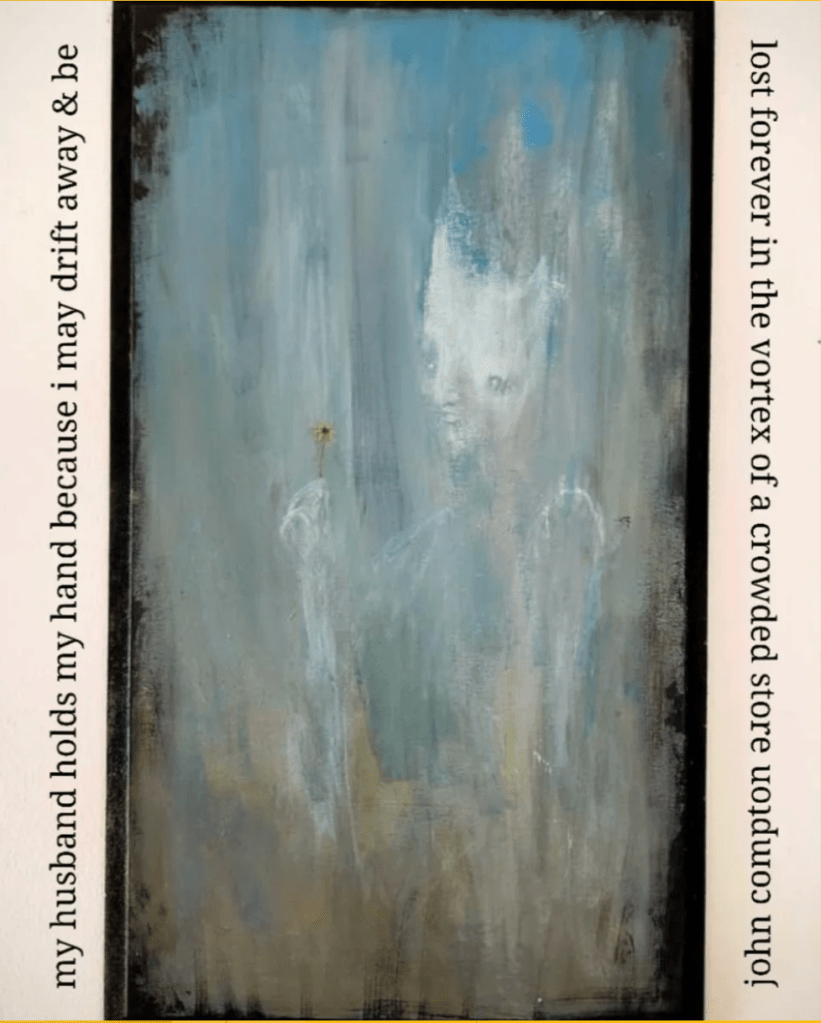
I want to quote myself before I quote you because I think of this poem often and want to further talk about it with you. From my review of your collection:
my husband holds my hand because i may drift away & be lost forever in the vortex of a crowded store,
I rather stupidly write:
In what I’ve decided is compton’s magnum opus, “the house in the attic”, the poet milks dry twelve pages of their life force, leaving the reader with a radiant, stand-alone poetic architecture mindfully in tune with (bear with me) Coleridge’s “Kubla Khan”.
Can you tell me more about the purpose? What are its influences? Length? Was that intended or did it grow on you?
jc: you never do anything stupidly. you’re quite brilliant. i’m glad you mentioned that poem and love that you believe it is my magnum opus. it is quite a wrap around type of poem about my life and the little moments inside it. a very brutally true poem, which i never think of and it took a moment to remember the poem you were questioning!
the house in the attic is one of a handful of the long poems i’ve ever written. i love the idea of going into an attic, getting lost in all the things clustered around, forgotten about, and entering multiple new worlds. in the same aspect, our minds are also attics with multiple houses, thoughts, experiences, and phases in life.
i don’t really know what influences me. i read a lot. i always say i have an auditiorum of dead poets in my head. in the beginning, i wrote a poem and stopped [maybe the first part], but someone read the poem and said they didn’t think it was finished, which of course sent me into a frenzy. the poem, thereafter, just bounced around and different ideas kept showing up, so they kept going into the poem. the — between stanzas hold the placement of a different day that part was written.
[john’s] favorite part of the poem:
you hold the voice to my ear
i turn into something that you eat
& crawl behind your teeth
engrave love words or letters
or statements in the enamel
to be read & reread
but you remove your jaw
my reentry from your mouth
into the noise
has me lost & humiliated
jc: which in part is a whole mess. the meaning: don’t get with someone who just wants to use you for sex. don’t try to stay with someone if they want no part in being in an actual relationship. you can try all you want but in the end the other person will still be what the other person decides to be.
i never intentionally set out to write any poem and usually the poem ends when my mind decides it’s over. i wrote the house in the attic about 13 years ago. it was originally published in my first chapbook “ampersand” in 2018, and republished in my full length.
Illness is everywhere in your poetry and online presence. You claim it before it claims you, or maybe it was the opposite and something we didn’t see. Our befores remain hidden but I’m curious about yours. Writing chronic illness sometimes feels like defeat. Your poetry swaddles itself in the heavy nourishment of toxicity and brings change in its development of a diseased ego that’s divorced from subject just enough for it to lend acerbic omniscience to the verse. You’re funny and very sad about it. What’s it like? What’s the experience been like for you? How did you decide to leverage yours and your husband’s terminal diagnoses for the literati? (There is no judgement, here, only a rare delight and admiration for what you’re doing).
jc: my mental health is as old as i am and i write about it so that i can live longer, in the way anne sexton wrote to survive. my physical health problems are new and so it’s a different experience and brings a newness to my poetry. for me, to write about something makes it less stigmatic.
my befores are what keeps tomorrow new. defeat is when you keep something a secret because then you become ashamed of it. i have [mental health] borderline personality disorder, generalized anxiety, major depression, and adhd; i also have [heart condition] afib, dod, and [nerve condition] peripheral neuropathy, which in itself comes with a long list of conditions.
i write about my husbands mental health issues so that i can continue to love him, because i know it’s the mental health issues that i do not love. and therefore writing about how much i hate them makes them a separate entity that i can see and materialize.
How did you harness personal calamities into online energy and four poetry collections (and counting)? What’s your daily writing schedule look like and do you have any cute opinions on what works and what stinks regarding productivity?
jc: writing poetry keeps me alive. it has been my only friend when i didn’t have any, my lover, my companion, and my therapist. for the longest time i didn’t have an audience or an idea that the poetry community existed.
i am lucky, blessed, and never take anything that i created for myself with the poetry community for granted. i’ve put all my life force into social media, marketing, and promoting.
i don’t necessarily have a writing schedule and i definitely do not write daily. i may edit daily, which i guess is like writing.
what works and what stinks! usually if i flat out hate my poem, it stinks. if i’m iffy about it 50% of the time it gets deleted after asking someones opinion.
Links? News? Please share anything you’d like me to cuddle an http:// to…

 Her Ghosts
Leave a comment