I’ve been unpopular for close to a decade in my approach towards mental health art-making. Stubbornly, I’ve written about it, written about it during the seasons of spare hope and doubled down during the more frequent lapses into a newly acquired despair. The mouths of my breaking points shout redly at me from the kitchen sink. Dredgy doesn’t suffice as descriptor for my writing, and look where it’s gotten me? Hated by several, a relative outcast in my hometown, (but!) someone whose furious stabs towards disability literature has made me friends in the strangest, subterranean places online. We’re all underwater. We’re all glimpsing the break of daylight on the surface several leagues above and exhaling–watery puss of bubbles and spittle and creature matter–exhaling so furiously it feels religious in its force towards examinable, stabilized existence. Lungs (they matter most dearly to us) lungs and the organ they take direct orders from, crucifying itself for the spent articles of sound and meaning we make. That’s the stuff of medical fairy tale maybe one day someone will write about. I want to let this interview speak for itself, and I encourage you to take thirteen minutes and read Em’s words in full. Full of strong lighting in the corners, Em’s way of handling things (societal shrapnel) is admirable and forthright. You can’t replicate Em’s honesty, but justice is served in an organic reading of it. I hope you enjoy their story as much as I did.
What’s it been like for you these last several months? Feel free to share your publication journey, discuss the amount of labor it took in regards to your project’s editing process, the delirious nature of third drafts, or that one late night you spent staring into a glass of wine, wondering if it’d ever truly come together.
My book came out in June last year so it’s mostly been quiet… the sort of annoyingly ultra-quiet you get when you’ve just finished the next thing and are tentatively sending it out.
I had written a short story, which followed the kid character, Cecil, when I was in college, but the setting and premise stayed on the boil for me for a decade. I expanded it to include more characters–more about his mom, a babysitter, the mystery of his missing dad and so on–and because I do a lot of interactive fiction and web game stuff, I considered writing it as a ‘Visual Novel’ script at one point.
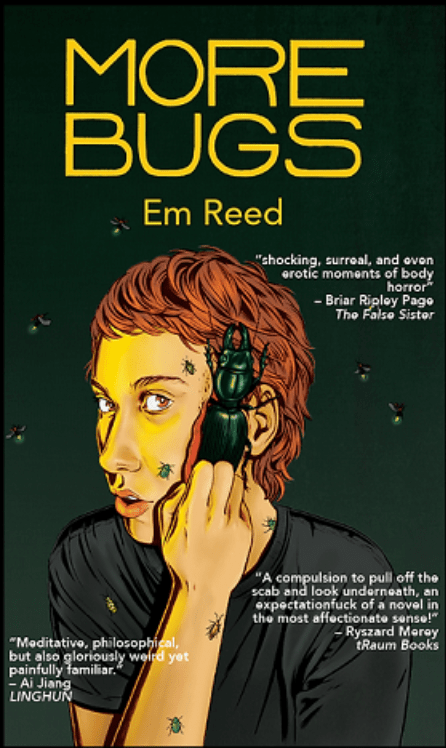
Around mid-2021 I got a standard 9-5 job, which ironically freed up more time and mental space to write (note: Em had freelanced for several years before this). I started writing specifically in Amy’s voice, and the angle and themes started coming together. I had some notes and outlines of scenes and did a full draft for NaNoWriMo, which came out to about 60k. Then, I did several months of editing, where it expanded to 96,000 words, and sent it out to agents and indie presses. Knight Errant was interested, and I thought it would be cool to work with a publisher that was nearby, plus, I loved their illustrative covers, so I was happy to go for it!
It was actually kind of cheeky of me to submit, because their stated limit was 85,000 or so… I have to live with the consequences of my bad behavior being rewarded now (LOL).
The editing before publication brought it back down to around 92,000 words… I also had the pleasure of getting to propose some artists for the cover, and we agreed on Lily Blakely, who does awesome, creepy, body horror comics. When we were done editing, I was kind of sick of looking at the thing, aside from the moments of self doubt where I’d be like “I’ve just ripped off the most boring Hallmark channel movie!” I still thought it was decent from a distance, and was excited to launch it.
I got to do a panel on launch day at Cymera festival in Edinburgh, where I also met David Lewis, who ended up putting the book in Strange Horizon’s 2024 in Review blog. Reviews and comments have slowed down, but it’s also a treat when one does show up, because this book is pretty special to me, even beyond being my debut.
Share freely any publication news you may have, and please include any links you’d like us to include.
The eBook version has recently come out, so you can check that out on Knight Errant’s website. I love the illustration and layout work that went into the paperback, but an eBook is definitely more accessible to a lot of people, especially due to how Brexit has affected international shipping (bleh!!). As for the “always be writing your next thing” advice, I recently finished a novella that I developed from an earlier short story, and have been busying myself with sending that out, while also daydreaming book 3. I’m in that ‘cool’ period where you just get to read books about interesting topics, listen to music, imagine your characters, and maybe write a scene outline or sentence or two until the whole plot arc comes together.
In two sentences, would you summarize your novel for us?
I would say it’s a slow-burning weird sf romance about how an encounter with the alien (literal and metaphorical!) forces the protagonist into finding new ways of loving and being loved. On a less thematic level, it’s about a broke artist having to move back in with her mom, and two things happen which may be related to the ongoing UFO sightings in the area – encountering her ex, who seems to be dating her doppelganger – and starting to babysit for a widowed mother down the street, who she of course develops a massive crush on.
You’ve mentioned in correspondence that mental health is featured throughout your novel. Was this something that you came into your project knowing you wanted to discuss? If so, did you set any parameters in place for yourself around how you wanted to approach this sensitive subject?
I didn’t really strongly plan on saying or representing something in particular about mental health when I started, but I knew that Amy’s voice and situation were so close to my own in my mid 20s that it would be an inevitable subtext. I think the edits after the initial draft really brought it out more explicitly, because I slowed down to think “how is she physically/mentally feeling in this situation” and how can I illustrate that with her actions? I struggled a lot from childhood on with what externally seemed to be periods of generalized anxiety or depression that just didn’t get better, or, if it was managed for a time with medication and a change of situation, it would still come back. I would get very panicky in school, or I wouldn’t know how to respond to social situations I hadn’t planned out in my head; I would feel like I really struggled to have close friendships and would have periods of being very harsh on myself for some quality or other I thought was stopping me from being socially accepted… sometimes the feeling of stress and failure would be so overwhelming that I’d be in that passively suicidal state of doing the bare minimum to get by, kind of hoping you just get deleted from the universe or something.
I was older than Amy when I experienced burnout–I felt like I’d lost all of my (minimal) social skills–I remember one instance where I was in the pub, with a mix of some people I knew and some I didn’t, and I was just frozen, I couldn’t say a word the whole evening. This happened alongside doing grad school, so I would be forcing myself to lecture and TA and do conference presentations and stuff, but then become a mole in my room the rest of the time. I felt petrified and exhausted if I took a second to breathe. After that point, I was diagnosed with Autism and found it as a useful frame for understanding what had been going on with me all along, especially with the episodes of burnout, struggling socially, and sensitivity to noise and disruptions.
“While [sometimes] the stuff for Generalized Anxiety or depression helped, approaches like CBT can also be totally unhelpful if there’s a chronic issue or unusual neurotype involved in the situation.“
I needed a different bag of tricks to manage all the aspects of it, and also gain understanding for when I needed to go easy on myself. So, how I depicted stuff in the book combines the wisdom of hindsight with the immediacy of experience.
Amy doesn’t know why she feels so alienated and overwhelmed by social situations or basic life scenarios that seem easy and attainable to everyone else, but having my own experiences re-contextualized in that way made it easier to bring into focus what is going on for her under the surface without explicitly naming it. There’s so much crossover in experience between mental health issues and neuroatypicality, I’m happy if all sorts of people find this representation valuable.
It was kind of a back-and-forth process, I’d think of things I now understood as playing a role in how desperate, frustrated, and alone I felt at the time, how I perceived and responded to them, and add that [to my writing], but some things also emerged from the process of drafting that made me reconsider stuff in my actual life. For example, how Amy often ended up thinking about drinking or wanting to drink to blitz her way through social situations as I was writing… what’s going on there? I thought about how often I did that in my own life, and how, even if it wasn’t like–a blackout drunk amount of alcohol–it was still a way I’d found of “forcing” myself to mask or deal with undesired social scenarios that was probably unsustainable and obviously also not fun for me. It kind of took me by surprise to make this connection, in part because so much of the information and cultural imaginary around autistic people is about young kids, who hopefully aren’t white-knuckling it through the work-social yet!
What is something you’d like readers to take away from your work in regard to mental health advocacy, discussion, or criticism?
I think so much of how we discuss and treat mental illness today–at a broad societal level anyways–is about norm enforcement. I often felt like the therapy I received for depression or anxiety was more about getting me to be a productive student or worker again rather than creating a life that was tolerable and worthwhile for me. Similarly, ABA for autistic children is often explicitly about punishing and in theory reducing supposedly “weird” or “annoying” behaviors for others’ sake.
In fact, it really bothers me how much mental health or neuroatypicality is used as a lever to control kids, or even adult children, by their parents, schools, and other institutions.
Outside of forced institutionalization, you see parents who want to deny their kids’ trans status and try to blame it on autism or depression, or they’ll block them from getting really important vaccines. Combined with the cost of medications and how hard it can be to get a job that provides good healthcare, even into adulthood, it can be a way of creating control by denying someone’s autonomy and ability to think for themselves, and trapping them in dependency. Many people don’t care that it can have fatal consequences.
I’ve had a therapist say that I only “thought” I was bisexual because social anxiety made me lonely and desperate! Fortunately, by that point, I had enough confidence in that aspect of myself and self-respect to drop that course of therapy… a few years earlier I may not have.
The exhortation to “be normal,” as if it’s just a base state that everyone can revert back to… it can feel like it’s coming from everywhere. Two nonfiction books that really helped me develop feelings of liberation around and an accepting attitude towards myself as a neurodivergent person who also struggles on and off with mental illness are Hamja Ahsan’s “Shy Radicals” and Robert Chapman’s “Empire of Normality“. However, the majority of the way I’ve coped with the general feelings of alienation that comes from this is through reading and writing fiction.
It’s the best feeling ever to get an email or comment from someone who says my book made them reconsider their idea of normalcy or shed light on some aspect of their own experience. For me, the positive aspects of a diagnosis put a pattern of things together in a way I now know many others also struggled with… I had a starting point of their experience and self-knowledge to make sense of my own experiences from.
I think that’s what’s valuable about representing these themes–-I’m less hot on treating diagnoses as ways to sort people or to use as rules to follow both at the individual, creative, and broader cultural level[s]; if you use one it should serve you, not the other way around.
There’s so much literature of alienation that I’ve found nourishing and informative, and it can span a magnificent range of approaches on how explicit they are about diagnoses. Picking up Kafka when I was 15 or so was so instantly compelling… I had enjoyed fiction before, but here I was like, wow! This is how it feels! I didn’t know someone could write like that. Which gives you an idea of how pleasant high school was for me… haha.
Anything else you’d like to share (or for us to share on your behalf?)
One thing that has given me a really solid social circle [a lot of friends who I can talk about this stuff with and also get feedback on my work from] is Domino Club. It’s a group of acquaintances from a few different contexts who decided to start an online game jam because we were bored during the COVID-19 lockdowns. It’s still alive in the present. I feel like I can really stretch my ideas and writing, making weird interactive fiction and webgames in a group like this. So, some of the ones on the site are mine, many more are by other members, but they’re all released under pseudonyms. There are no specific rules, but the theme is most often surreal and weird sci-fi, horror and fantasy.
Drop any social media or website links you’d like us to link to in the interview.
More Bugs – https://emreed.net/more_bugs
Knight Errant Press – https://www.knighterrantpress.com/
Lily Blakely – https://www.lilybla.co.uk/
Cymera – https://www.cymerafestival.co.uk/
David Lewis – https://www.daviddaviddavid.com/
Strange Horizons 2024 in Review Blog – http://strangehorizons.com/non-fiction/2024-in-review-part-two/
More Bugs Ebook – https://www.knighterrantpress.com/product-page/more-bugs-by-em-reed-1
Shy Radicals – https://bookworks.org.uk/publishing/shop/shy-radicals-the-antisystemic-politics-of-the-militant-introvert-2017-fourth-edition-2020/
Empire of Normality – https://www.plutobooks.com/9780745348667/empire-of-normality/
Domino Club – https://domino.gallery/
My homepage is emreed.net and I’m on Bluesky as @dayofthemutants@bsky.social
 Her Ghosts