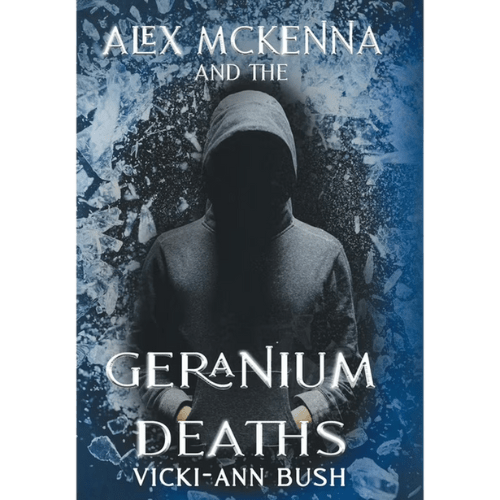
Vicki-Ann Bush and I met over Zoom on Saturday, March 29th, to discuss her Alex McKenna YA Paranormal LGBTQ series [Website]. The interview was recorded on my iPhone. I’ve made every attempt to accurately transcribe her responses without diminishing the distinctive flow and cadence of our conversation. The interview was capped at 15:19 minutes. Speaking with her divvied up the genuine delight over how I feel about this project in general — what SSBA’s doing — and the authors they’ve chosen to place brisk spotlight on and toss microphone to. Despite the interview’s late appearance due to the blind-siding effects of turbulence in my personal life this Spring and Summer, I’m hopeful that Bush will impact thousands with her concept and empathy. I’m late, I know, and I’m sorrier still sitting next to a .docx draft and cold coffee and this opportunity for confession. Timeliness in an interview not only gives the voices considered additional power, but it speaks of respect and something I reference too often already: honor. Vicki-Ann Bush’s central character, Alex McKenna, takes his business at wrecking traditionally teenage stereotypes with strident élan for the new normal: there is none, and pointing to history for argument of its existence is the friendly acquaintance of homogenous fanaticism. The good-riddancy of drowning expectations is alive, robustly young, and dogmatically well in Bush’s series. Despite this summer’s setbacks, it’s a privilege to gauge the minds of some of indie literature’s most subversive speculative voices today. Recording their ingenuity makes me wonder what’s next on the horizon for slipstream, and how, as a community of artists and scholars, we can manufacture genre so as to champion inclusivity around disability, impairment, and gender. Inciting mutation in the robust bracket of societal standards is the collective’s responsibility and antediluvian gift. It only takes one voice to edify a question for thousands. That thousand has the ethical obligation to expound upon and justly illustrate, make whole again the terrific error of oversight and prejudice. With that being said, it was a tremendous honor sitting down with Bush to discuss her activism and views on effectively handling the delicate—crucially imperative–thematic elements of mental health writing in character narratives.
MB: What’s it been like for you these last several months? Feel free to share your publication journey, discuss the amount of labor it took in regards to your project’s editing process, the delirious nature of third drafts, or that one late night you spent staring into a glass of wine, wondering if it’d ever truly come together.
VAB: First of all, with the Alex McKenna series, this is a second edition, so the series originally came out – the first book – in 2019, but I was with a different publisher. And when the publishing company was going through a sale, my contract was also up for renewal, and I opted not to, because I didn’t feel it was the best fit for me. I’m with a new publisher that I had originally gotten for a couple of other books, and then I started talking to them about Alex. And they offered me the contract. So, all four books are now releasing under Creative James Media, which is very exciting. The first book was re-released in 2023 – towards the end of the year – and the second book came out at the end of 2024; the third book came out in the beginning of February of 2025 of this year. For this particular series, the fourth book – Forest – will be out in October of this year.
The process of editing [laughter] has been like a giant boulder running after me as I flee–[laughter] because it’s been a lot of edits. You know, between – I don’t mean the amount of edits – but the amount of time. Usually, you know, you write a book, you go through the edits, the book comes out, and it might be a couple of years. This [experience] has been consistent, because they [Creative James Media] wanted to go through and make sure the books were perfect, and to just adjust or assess anything that we had felt needed to be updated or changed.
So, it’s been a constant editing process going on. But it’s good. It’s good because I’ve found some things that were missed the first time around that I am able to correct, and make sure that it’s consistent. You know, when you’re writing a series, even though the books are standalone within the series, there’s things in there that you just have to have continuity with, whether it be something like the color of Alex’s eyes or his catchphrase that he used or what his grandmother calls him. [It] has to be consistent throughout all the books. So that’s been – well, even though it was a little daunting – it’s also extremely positive.
MB: Yeah, no, it sounds like you’re doing a wonderful job and I can’t imagine trying to match everything between that amount of books – that’s a headache – but worthwhile project. Okay, wonderful. Next – I’d like to invite you to share freely any publication news you may have for us.
VAB: That would be the fourth book for this particular series. I do see other things coming in the future, but I haven’t gotten there yet. For this particular series, the Forest book will be out in October, and I think, in my opinion, it’s Alex’s darkest book yet, because in that particular story, he confronts the bully that has been bothering him at high school for the past few years. So, it’s kind of like, yes, we’ve got all the paranormal and all of that fun, but there’s also that mental conflict of, do I help this person who is literally wanted to torture me–you know–mentally, for the past few years, or do I walk away?
MB: And that’s wonderful, too. How old is Alex in the novel?
VAB: He’s 17, and then by the fourth book, he’s getting closer to 18.
MB: Well, that’s a potent example for teens who might be reading this book as well, because, I mean, bullying is a prevalent thing in schools these days, so I love to hear that. Um, so in two sentences, if you can, would you summarize your novel for us?
VAB: Could I summarize the series as opposed to just the novel?
MB: Of course, yeah.
VAB: A 17-year-old transgender boy with extraordinary abilities and extraordinary choices.
MB: So you’ve mentioned in our correspondence that mental health is featured throughout your novel, or your series. Was this something that you came into the project knowing you wanted to discuss, and if so, did you set any parameters in place for yourself around how you wanted to approach this sensitive subject? Or, was it something that sort of happened organically as you wrote the series? Does that make sense?
VAB: Yeah, it does. It’s a little bit of both. The character was created because of someone very close to me. And I wanted them to have the kind of character that they could relate to. But they get lost in the fantasy of the paranormal, so the focus is not on Alex’s transgender journey – although it is a very important part of it – that’s not what we’re focusing on. So, in the beginning, when I was writing scenes, obviously, this is a teenage transgender boy, I wanted to be sure that I got… certain things right, whether it be a short doctor’s visit, or some emotions he’s feeling about certain things. I connected with the LGBTQ community center in Las Vegas. And I was able to talk to the head of the transgender department and sit down and say, this is what I have. And as I wrote certain scenes in the book, I would send the scenes to him so he could say, yeah, this is how it would be done. Or –
MB: That’s incredible.
VAB: Yeah, yeah – it was extremely helpful. And then, as the books went on – throughout the second and third books – and as I was writing, the transgender part gets a little bit less and a little bit less. And the reason I do that is because, once again, I want to bring this into Mainstream, where Alex is transgender, but okay. Alex is who Alex is. We’re looking at a teenage boy that has these extraordinary abilities, you know, beyond the normal psychic, beyond what you would deem as every day, okay?
MB: Okay, okay, yeah.
VAB: And that’s where we want to take it. So, once that started to happen even more and more, then I basically – after that – started winging it. But the cement, the base was definitely planned.
MB: And that you reached out and asked young people who were going through that experience, to make sure that the lived experience was authentic to your character.
So, what’s something you would like readers to take away from your work regarding mental health advocacy, discussion, or criticism? You answered that question already, but is there anything else you’d like to add?
VAB: I would, I would. I found – just observing going in – that the center was such a good place for the teens to go to, be able to express themselves, meet people who are helpful, have groups that could encourage them. I sat in on one particular group that… it really hit me, and I didn’t expect it. It was kind of like a tornado that just came out of the blue. The kids who were talking about pronouns. So, I thought, okay, we’ve got to get this right, but I didn’t realize how much—how much—this affects them mentally…until I actually sat down and listened to them come up. And there were a lot of emotions. I mean, I cried through the whole thing because you don’t realize the impact of something that you may deem as small, or insignificant, and it’s not, it’s not. So, I would say if they can get involved, if they have a Q community or LGBTQ community center that they can utilize to go to and sit down and talk to people and engage — so that they know that they’re not alone — because that’s the worst feeling of all, thinking you’re alone in this journey. And the person I wrote the book for – the character – is very fortunate to have family that is very supportive, but some of the kids I met didn’t have that. And it’s so important. So, if they don’t have it, especially if they don’t have it at home, they need to make, you know, they need to have it in it in other places.
MB: Well, that’s profound. I couldn’t agree more. A pronoun is so much more than just – it’s an identity. Is there anything else you’d like to share with us on your behalf or your series’ behalf? Anything you’d like us to know?
VAB: I don’t know if we discussed this, but [I have] an award-winning short film out right now. I wrote a script—it got produced by a small production company—and it’s a prequel to the books.
MB: Oh, congratulations!
VAB: It’s – thank you. [laughter] It’s [about] what if this is how Alex told Margaret he was transgender? So, in the books, we pick back up where they’re basically boyfriend and girlfriend, right? But we don’t really have too-too much of the backstory as to how this happened. How did they go from friends to where they are now? It’s brushed over a little bit in the first book, but it doesn’t actually break down any of the dialogue or anything that’s happened. So that’s what this [the film] is. It’s a short film. It’s on a few streaming platforms, but honestly, the easiest way to get is by either going to my website or going directly to YouTube: “Alex and Margaret’s Beginning”. It’s 20 minutes, but we’re lucky that it’s gotten recognized, and it has substantial awards behind it, which is really mind-blowing to me. And since that happened, I recently finished a screenplay adaptation of the Geranium Deaths, the first book. So, I’m going through the process now of trying to get that out there, because that’s going to need a bigger production company.
MB: Going from prose to a screenplay is… I’ve tried to adapt a story before into a screenplay and it was a complete mess… so that, I mean, that’s an undertaking.
VAB: Totally different [laugher]. Yes, I was lucky with the short film. I did have a mentor who was able to guide me in the actual execution of it. You know, because you write a novel and you’re used to telling a story and you have time, right?
MB: Yes.
VAB: And I remember when I did my first draft, he came back to me and he’s like, “okay — the viewer isn’t going to know what’s in the character’s head. You have to show everything, because I was writing these descriptions in between, and it wasn’t for the viewer. It was just instruction to [it] when we were filming.
MB: Yeah, makes sense. I’m glad to hear it. That’s so exciting. And I wanted to ask you to drop any social media or website links (which you’ve already done). Is there anything, or any other social medias or platforms that you’d like me to include in the interview when we publish it?
VAB: The link I gave you is my landing page, so it literally has everything on it.
MB: Perfect.
VAB: Yeah.
MB: Well, thank you. I try to keep it short, you know, so I don’t take up too much of y’all’s time, but thank you so much for meeting with me. I really appreciate it.
VAB: And thank you. Thank you so much for what you’re doing, and thank you for giving myself and others a platform.
IG:
http://www.instagram.com/vickiannbush
Website:
Watch on YouTube:
 Her Ghosts